

In this PrepScholar ACT review we’ll dig into what the company actually rebuilt for the Enhanced ACT, what the four packages cost, and how it stacks up against Kaplan, Princeton Review, Magoosh and the free official practice ACT gives you.
We’ll tackle some of your hard-hitting questions – is PrepScholar worth it and does it work to prepare you to ace the exam come test day? Read on to find out!
Pros
- Material genuinely rebuilt for the Enhanced ACT – math rewritten for four answer choices
- Built-in AI tutor that teaches rather than just answers (on the $495 tier)
- Coverage of critical test prep strategies (great benefit for anxious test-takers)
- Diagnostic-driven weekly study plan, not just a question library
- 12 months of access, double what Kaplan gives you
Cons
- Not the cheapest self-paced ACT course – Kaplan and Magoosh both undercut it
- No mobile app, and no physical books with the standard course
The Verdict
The ACT was rebuilt in 2025, which means a great deal of the prep material still on sale was written for a test that no longer exists. Getting that right matters more this year than any other single thing, and it’s where PrepScholar is strongest: 54 skill lessons refreshed for the Enhanced ACT, math questions rewritten for the new four-choice format, and science lessons you can switch off if you’re not sitting that section. That’s a documented rebuild, not a badge on a homepage – and it counts for more than any spec on the page, because drilling five-choice math trains instincts you can’t use on test day.
The second thing you’re buying is a plan. PrepScholar runs a diagnostic, works out what’s actually weak, and hands you a week-by-week schedule. Most rivals hand you a library and a search box, which is fine if you already know what to do with one. If you’re studying alone, that structure is the product – and the AI Learning Assistant on the $495 tier means there’s something to ask at eleven at night when a written explanation doesn’t land.
At $397 it isn’t the cheapest self-paced ACT course, and I’ve set out the full comparison further down. What the extra buys is twelve months of access rather than six, material demonstrably rebuilt for the test you’re actually taking, and a program that decides what you study each week so you don’t have to.
Buy it if you’re sitting the Enhanced ACT, studying alone, and you’d rather be told what to work on each week than work it out yourself. Skip it if you’re on a tight budget, disciplined enough to build your own plan, or you want live instruction – Kaplan and Princeton Review both do that better.
About PrepScholar
Founded by a pair of Harvard grads, PrepScholar offers programs for multiple tests at the pre-college and post-graduate levels, not just for the ACT and the SAT. Student sentiment has warmed up considerably since I first looked at the company: it now holds a 4.7 out of 5 on Trustpilot across 301 reviews, alongside a 4.4 overall score on BestCompany, where 35 reviewers left an average of 3.3 stars. The Trustpilot figure is the one I’d weight, simply because the sample is close to ten times larger.
What Changed on the Enhanced ACT
The ACT you’re about to sit is not the one your older sibling sat. The changes rolled out from April 2025 and finished landing across all testing windows in 2026:
- Science is optional, and it no longer counts toward your composite. Take it and you get a separate STEM score instead.
- The composite is now the average of English, Math and Reading – three sections, not four.
- The core test shrank from 215 questions to 131, and from 175 minutes to about 125.
- Math answer choices dropped from five to four.
That last one looks like a footnote. It isn’t. Almost every math strategy worth knowing runs on the number of answer choices. A blind guess went from 20% to 25%. Eliminate two and you’re at 50% rather than 33%. Backsolving – plugging the answers back into the question – got roughly 20% faster because there’s one less answer to plug.
So if you spend the autumn drilling five-choice math questions, you are rehearsing arithmetic you will not be doing on test day. Which reframes the question of which course to buy: not who has the most practice questions, but whose questions match the test you’re actually going to sit.
PrepScholar Pricing Options
PrepScholar sells its ACT prep four ways, and all four run on the same underlying program – what changes is what gets bolted on top. The entry point is the flagship Complete Online ACT Prep at $397, and for most students that’s the one to look at first.
Here’s how the four ACT packages compare:
As is the case for most prep offerings, the real premiums come with live instruction and one-on-one tutoring. Most ACT preppers don’t necessarily need these services to dramatically improve their scores but if you have the extra cash available the help offered by the testing experts at PrepScholar can likely bump your score up a few extra points, which may be worth the investment.
PrepScholar Curriculum Review
One of the best features of PrepScholar is the personalized curriculum generated for each student based on a variety of factors like:
- Area of focus (math, reading or writing – or all three)
- Desired score improvement
- Time you can commit each week

Before you begin your test prep, PrepScholar is already customizing your prep strategy based on a series of questions when you sign up.

Some of the questions they ask include:
- Your dream school
- Your target score (1-36 on each section)
- Any extended time accommodations available to you (in the context of the ACT, these are only offered to students with documented disabilities that cause them to work more slowly than others; the vast majority of test-takers do not qualify for these provisions)
- The components of the test you struggle with most
They also ask (for marketing purposes, presumably) about how you discovered PrepScholar, how likely you are to recommend test prep services to a friend, etc.
Once you get registered and settled in for full-swing prep, it’s time to hit the books. Below, we’ll cover the actual lesson content, how the platform works, and pros and cons of the PrepScholar program versus competitors.
PrepScholar Lesson Content
As the company continuously reminds you before and after purchasing its courses, expert educational professionals design the lesson content. Accordingly, it’s very well-developed and well-structured.
PrepScholar really provides great graphics to accompany the text that illustrate the often-complex material (especially in the science section) that is otherwise difficult to explain using the limited medium of language alone.

At the end of each lesson, you’ll take a quiz to test how well you absorbed the presented material. After you finish, you can access detailed explanations for the correct answer as well as tips for how to reach the right one if you don’t necessarily know for sure (what your elementary teacher used to call an “educated guess”).

To summarize, the standout points of PrepScholar’s lesson content are:
- Well-partitioned subject matter
- Helpful visual aids to accompany verbal instruction
- End-of-lesson quizzes complete with thorough explanations for the correct answers
In addition to the lessons covering the actual material on the test, PrepScholar also offers a plethora of “strategy lessons” that cover various aspects of strategic test-taking from the basics like “Preparing for the Day of the Test” to more advanced ones like “Stress and Anxiety—Dealing with It.” You can even learn the best tips for applying to the school of your choice after you score high on the exam.

These strategy lessons are particularly helpful for those of us who struggle with test-taking more so than, perhaps, with the actual material. As work published in Psychology Research explains:
“Some students do poorly in tests because of the lack of test-taking strategies or the use of poor ones. These have both direct and indirect effects on students’ performance. Directly, these strategies help students increase their scores on tests through the effective use of their time, effort, and test conditions. Indirectly, using appropriate test-taking strategies affects other related but important factors such as reducing test anxiety and improving students’ attitudes toward tests.”
What that means, basically, is that how you take the test may be just as important as what you know. Acing the ACT or SAT, accordingly, depends not just on a familiarity with the material but also on a strong strategy to approach the test.
This is where PrepScholar really delivers ahead of other test prep companies that either fail to emphasize the importance of well-developed test-taking strategies for success or neglect them altogether.
PrepScholar Questions Bank
The ACT program comes with an arsenal of more than 3,000 practice questions, and the math ones have been rewritten for the Enhanced ACT’s four-choice format rather than carried over from the old five-choice test.
One of the handiest features that I appreciated most during the process was the quiz generator.

How the quiz generator works:
- Select the topic area broken down by the four subjects of the test (English, math, reading, and science)
- Choose the number of questions (5 or 10)
- Answer the questions in the allotted timeframe (a counter in the corner keeps track of how you’re doing timewise)
- Review your performance
- Get detailed explanations for each answer which include both the reasons why the correct answer is, in fact, correct, as well as test-taking tips that will help you suss out the right answer when you aren’t sure (again, mastering the “educated guess” game)
As you work your way through the content, PrepScholar will index all the incorrect answers in, appropriately so, the “incorrect answers” tab on the platform. There, you can go back and review the questions you got wrong and, more importantly, why you got them wrong to avoid similar mistakes when the same types of queries pop up on the real test.

PrepScholar AI Learning Assistant
The biggest change to PrepScholar’s platform in years, and the one that actually alters how you use the program day to day: there’s now an AI tutor – PrepScholar calls her Aila – built directly into the course. She sits in a panel to the right of whatever practice question you’re working on, and she comes with the $495 Complete Online Prep + AI Learning Assistant tier.
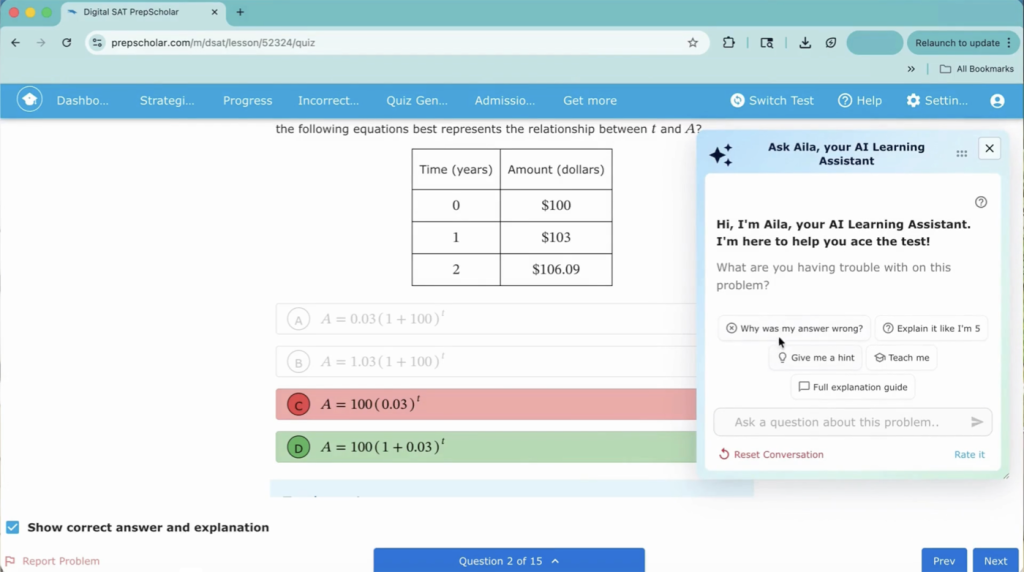
Now, I’ll admit I braced myself for this one. Every company on earth has bolted a chatbot onto its product in the last couple of years, and most of them amount to a search box with extra steps. This one is different in a way that matters, and the difference is that it flatly refuses to just tell you the answer.
Open her up on a question and she gives you a way in: Why was my answer wrong?, Give me a hint, Teach me, and – my favorite bit of plain speaking from a test prep company – Explain it like I’m 5. There’s a full explanation guide too, if you’d rather just read the thing through. A small touch, but it solves the blank-page problem of not knowing what to ask.
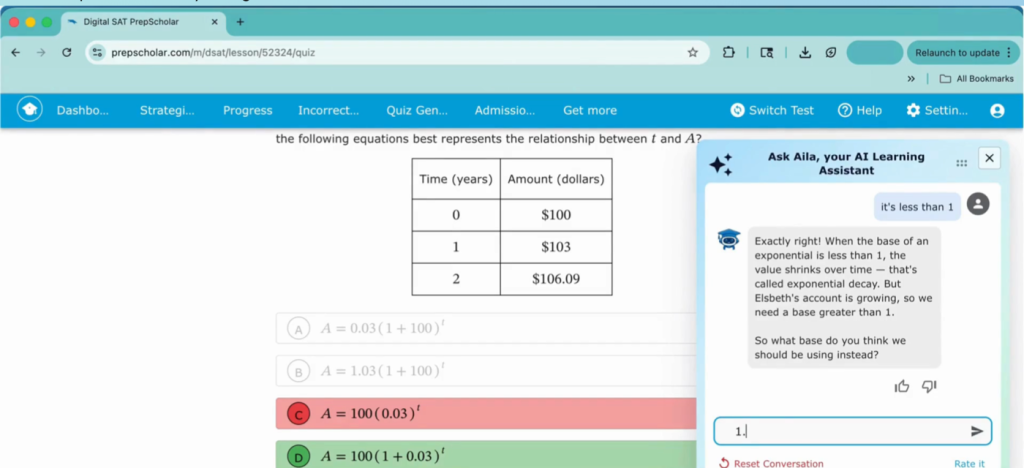
Ask about a question you’ve missed and Aila comes back with a question of her own. In the screenshot above, a student working an exponential growth problem gets walked along in stages – what does the formula give you at t = 0? Right, so that part checks out. Now try t = 1 – until they land on the answer themselves. That’s the Socratic method, and it’s exactly what a good human tutor does when you beg them to just hand it over. It is, deliberately, a little bit annoying. It’s also how people actually learn things.
A few specifics worth knowing:
- She can see the question you’re on. Aila has the context of the actual problem in front of you – passages, charts, and graphs included – so you’re not copying and pasting a question into a chat window and hoping the thing understood the graph.
- She’s trained on PrepScholar’s own material. Their lessons, their strategy guides, their question bank – rather than a general-purpose model with “you are an ACT tutor” stuck on the front of it.
- She’s there at eleven at night. This is the real pitch, and it’s a good one.
That last point deserves unpacking, because it goes at the single biggest weakness of every self-paced course ever made, PrepScholar’s very much included. You hit a wall on some skill, you read the explanation, you still don’t follow it, and there’s nobody to ask. So you quietly decide that geometry isn’t your thing and move on. Every self-study student has done this at least once. Having something to ask in that exact moment is worth more than another thousand practice questions in the bank.
So, is it worth the extra $98? My honest read: if you learn well from written explanations, probably not. PrepScholar’s answer explanations have always been one of the program’s genuine strengths, and for plenty of students they’re entirely enough on their own. But if you recognized yourself in the paragraph above – if you’re the sort who reads the explanation, still doesn’t get it, and quietly gives up on that skill – then $98 to have something to ask is money well spent. That’s precisely the failure mode this thing is built to catch.
One caveat before you reach for your wallet: Aila only comes with the $495 tier. The standard $397 course doesn’t include her, so if this is the feature that sold you, that’s the package you want.
PrepScholar Video
For the visually oriented among us, each lesson comes with its own video.

These are typically PowerPoint-style videos with text, diagrams, graphics, etc. narrated over by the instructor – which can become a bit dull and not super-stimulating over time, but they get the job done with tons of helpful examples of questions you’ll encounter on the actual test as well as detailed explanations for how to arrive at the correct answer.
Accompanying each lesson video, of course, is text below, so you don’t need to rely on the videos if you prefer to move through the lesson at your own pace.
PrepScholar Customization
PrepScholar does a decent job of customizing its approach to prepping you to ace the exam. As we discussed previously, incoming students must fill out a questionnaire covering the testing areas they are most interested in improving upon, their target score, etc.
In addition, the next step of the onboarding process is a diagnostic test to assess your current state of preparedness.

After finishing the timed 60-question diagnostic exam, you’ll select your planned real-life testing date, watch a brief intro video, and then key in how much time you specifically plan to devote to studying.

Although the volume of info that PrepScholar asks for can seem overwhelming (and, honestly, a little annoying; why do you need to know my planned study schedule for the week, mom?), it actually proves to be beneficial for keeping on target with your study goals if you are prone to procrastination (you know who you are). It’s especially helpful to get regular reminders via text message that it’s study time.
Of course, if self-discipline is a skill you’ve already mastered at a young age, you might not need the level of structure and customization that PrepScholar provides.
So, after you’ve jumped through all the hoops, PrepScholar generates a personalized study plan based on all the info you’ve provided as well as the results of your diagnostic test.

PrepScholar Platform Review
The platform is intuitive and user-friendly. When you log into the interface, you will notice it is broken up into the following sections:
- Dashboard
- Strategies
- Progress
- Incorrect Answers
- Quiz Generator

Under the “progress” tab, you can easily track all of the lessons you have completed, organized by both subject and topic – for example, “pronouns” under the “English” banner and “experimental design” under the “science” banner.