

These are the hardest and easiest AP classes based on how students actually scored in 2026. College Board publishes the full score breakdown for every AP exam, and we ranked all 40 by pass rate: the share of test takers who scored a 3 or higher.
Prepping for the SAT too? Start here.
Hardest and Easiest AP Classes at a Glance
| 10 hardest (lowest pass rate) | 10 easiest (highest pass rate) |
|---|---|
| Music Theory (59%) | Research (90%) |
| Statistics (62%) | Seminar (88%) |
| Computer Science Principles (63%) | Chinese Language and Culture (85%) |
| Calculus AB (65%) | 2-D Art and Design (85%) |
| World History: Modern (66%) | Spanish Language and Culture (83%) |
| Macroeconomics (66%) | Drawing (83%) |
| Human Geography (66%) | Calculus BC (82%) |
| Computer Science A (66%) | Precalculus (82%) |
| Art History (67%) | African American Studies (77%) |
| Physics 1 (68%) | U.S. Government and Politics (76%) |
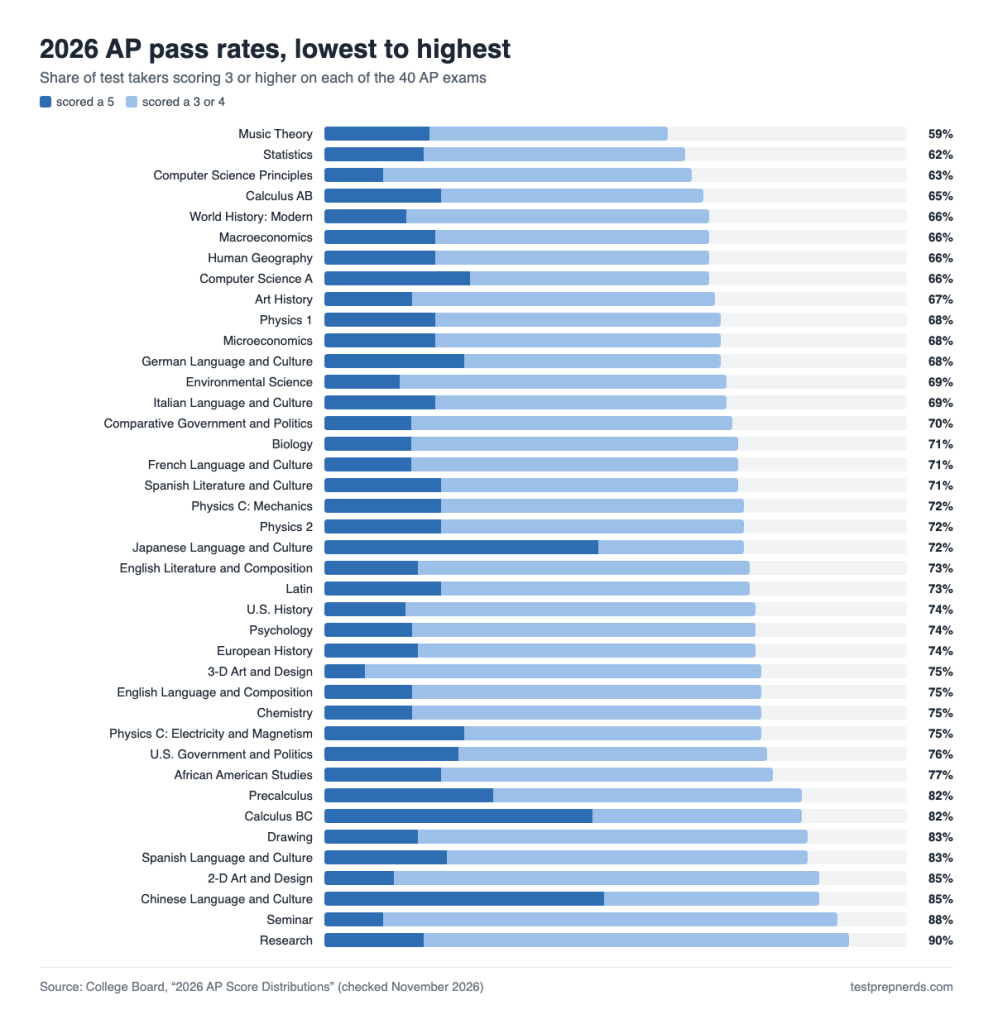
Pass Rates Don’t Tell the Whole Story
A low pass rate doesn’t always mean the hardest material, and a high one doesn’t mean an easy class. Who takes each exam matters as much as the content:
- Advanced students raise pass rates. Calculus BC covers more than Calculus AB, but 82% passed BC against 65% for AB, because BC students are usually strong in math already.
- Native speakers raise world language scores. Nearly half of AP Chinese and AP Japanese test takers scored a 5.
- First-time AP students lower pass rates. Human Geography and Computer Science Principles are common first AP classes, and their pass rates are among the lowest.
- Portfolio and project courses score differently. AP Research, AP Seminar and the art portfolios are graded mostly on work done during the year, not one timed exam.
Use the numbers as a starting point, then weigh them against your own strengths and your school’s teachers.
All 40 AP Exams Ranked by 2026 Pass Rate
Ranked from lowest pass rate to highest, from College Board’s 2026 AP score distributions. Ties are broken by the share of 5s.
| Rank | AP exam | Pass rate (3+) | Scored a 5 | Scored a 1 |
|---|---|---|---|---|
| 1 | Music Theory | 59% | 18% | 15% |
| 2 | Statistics | 62% | 17% | 21% |
| 3 | Computer Science Principles | 63% | 10% | 16% |
| 4 | Calculus AB | 65% | 20% | 11% |
| 5 | World History: Modern | 66% | 14% | 8% |
| 6 | Macroeconomics | 66% | 19% | 14% |
| 7 | Human Geography | 66% | 19% | 10% |
| 8 | Computer Science A | 66% | 25% | 23% |
| 9 | Art History | 67% | 15% | 9% |
| 10 | Physics 1 | 68% | 19% | 17% |
| 11 | Microeconomics | 68% | 19% | 12% |
| 12 | German Language and Culture | 68% | 24% | 10% |
| 13 | Environmental Science | 69% | 13% | 16% |
| 14 | Italian Language and Culture | 69% | 19% | 11% |
| 15 | Comparative Government and Politics | 70% | 15% | 12% |
| 16 | Biology | 71% | 15% | 8% |
| 17 | French Language and Culture | 71% | 15% | 6% |
| 18 | Spanish Literature and Culture | 71% | 20% | 9% |
| 19 | Physics C: Mechanics | 72% | 20% | 11% |
| 20 | Physics 2 | 72% | 20% | 7% |
| 21 | Japanese Language and Culture | 72% | 47% | 21% |
| 22 | English Literature and Composition | 73% | 16% | 11% |
| 23 | Latin | 73% | 20% | 10% |
| 24 | U.S. History | 74% | 14% | 8% |
| 25 | Psychology | 74% | 15% | 8% |
| 26 | European History | 74% | 16% | 8% |
| 27 | 3-D Art and Design | 75% | 7% | 2% |
| 28 | English Language and Composition | 75% | 15% | 10% |
| 29 | Chemistry | 75% | 15% | 6% |
| 30 | Physics C: Electricity and Magnetism | 75% | 24% | 8% |
| 31 | U.S. Government and Politics | 76% | 23% | 8% |
| 32 | African American Studies | 77% | 20% | 6% |
| 33 | Precalculus | 82% | 29% | 7% |
| 34 | Calculus BC | 82% | 46% | 4% |
| 35 | Drawing | 83% | 16% | 3% |
| 36 | Spanish Language and Culture | 83% | 21% | 3% |
| 37 | 2-D Art and Design | 85% | 12% | 3% |
| 38 | Chinese Language and Culture | 85% | 48% | 9% |
| 39 | Seminar | 88% | 10% | 2% |
| 40 | Research | 90% | 17% | 2% |
The 10 Hardest AP Classes
1. AP Music Theory
Pass rate (3+): 59% · Scored a 5: 18% · Scored a 1: 15%
The lowest pass rate of any AP exam, and 15% of test takers scored a 1. It’s a different kind of test: besides written theory, you’re graded on listening skills such as identifying chords and taking melodic dictation, plus sight-singing. Students without ear training tend to struggle most.
Our pick for AP Music Theory review:

2. AP Statistics
Pass rate (3+): 62% · Scored a 5: 17% · Scored a 1: 21%
About one in five test takers (21%) scored a 1. Statistics rewards clear written reasoning as much as calculation, which catches out students who expect a math test. The course has been revised for the 2026–27 school year, so use a review book written for the revised exam.
Our pick for AP Statistics review:
Complete content review for the revised AP Statistics exam, with 5 full-length practice tests (2 in the book, 3 online) and practice drills in every chapter.

3. AP Computer Science Principles
Pass rate (3+): 63% · Scored a 5: 10% · Scored a 1: 16%
Only 10% earned a 5, one of the lowest rates of any exam. CSP is often a student’s first computer science course, and its exam pairs a multiple-choice section with a programming project you build during the year.
Our pick for AP Computer Science Principles review:
Written for the new 2026 AP Computer Science A exam, with 5 full-length practice tests, Java content review and digital practice online.

4. AP Calculus AB
Pass rate (3+): 65% · Scored a 5: 20% · Scored a 1: 11%
A quarter of test takers (24%) scored a 2, just below passing. AB’s pass rate is well below Calculus BC’s, which says more about who takes each exam than about the math: BC covers everything in AB and more.
Our pick for AP Calculus AB review:
Princeton Review’s guide for the updated AP Computer Science A exam. It covers all the Java content you need, explains how each question type works, and includes 5 full-length practice tests plus digital practice online.

5. AP World History: Modern
Pass rate (3+): 66% · Scored a 5: 14% · Scored a 1: 8%
Only 14% earned a 5, and 26% scored a 2. The course spans about 800 years of history across every region, and the essays are graded on how you use evidence, not just what you know.
Our pick for AP World History: Modern review:
Content review for AP World History: Modern with 6 practice tests and digital practice online. Its online tools are updated for the 2027 exam changes.

6. AP Macroeconomics
Pass rate (3+): 66% · Scored a 5: 19% · Scored a 1: 14%
14% scored a 1, more than most exams. Macro is built on graphs and models, and students who memorize definitions without practicing the graphs tend to lose the free-response points.
Our pick for AP Macroeconomics review:
One book for both AP Microeconomics and AP Macroeconomics: content review, 4 practice tests and digital practice online.

7. AP Human Geography
Pass rate (3+): 66% · Scored a 5: 19% · Scored a 1: 10%
Human Geography has a reputation as an easy AP class, but only two thirds of test takers passed. It’s often taken by freshmen as their first AP course, which pulls the numbers down.
Our pick for AP Human Geography review:
AP Human Geography content review with 6 practice tests and digital practice online.

8. AP Computer Science A
Pass rate (3+): 66% · Scored a 5: 25% · Scored a 1: 23%
The most split result of any exam: 25% scored a 5 and 23% scored a 1. Students who can already write Java do very well; students who can’t tend to fail.
Our pick for AP Computer Science A review:
Written for the new AP Computer Science A exam, with 5 practice tests, Java content review and digital practice online.
9. AP Art History
Pass rate (3+): 67% · Scored a 5: 15% · Scored a 1: 9%
The course covers 250 required works of art, and the exam expects you to recognize and analyze them. Only 15% earned a 5.
10. AP Physics 1
Pass rate (3+): 68% · Scored a 5: 19% · Scored a 1: 17%
17% scored a 1. Physics 1 is algebra-based but heavy on conceptual reasoning, and it’s many students’ first physics course.
The 10 Easiest AP Classes
1. AP Research
Pass rate (3+): 90% · Scored a 5: 17% · Scored a 1: 2%
The highest pass rate of any AP exam. There’s no traditional exam: you’re graded on a year-long research paper and a presentation. You need to have taken AP Seminar first, so everyone in the course has done this kind of work before.
2. AP Seminar
Pass rate (3+): 88% · Scored a 5: 10% · Scored a 1: 2%
Most of the score comes from projects and presentations done during the year, with a shorter end-of-course exam. 57% scored a 3, the most of any exam, but only 10% earned a 5.
3. AP Chinese Language and Culture
Pass rate (3+): 85% · Scored a 5: 48% · Scored a 1: 9%
48% scored a 5, the highest share of any exam. That likely reflects who takes it: many test takers already speak Chinese at home. For students learning it from scratch, it’s a hard exam.
4. AP 2-D Art and Design
Pass rate (3+): 85% · Scored a 5: 12% · Scored a 1: 3%
A portfolio course with no sit-down exam: you’re scored on work you create and submit during the year.
5. AP Spanish Language and Culture
Pass rate (3+): 83% · Scored a 5: 21% · Scored a 1: 3%
Only 3% scored a 1. As with Chinese, many test takers are native or heritage speakers.
6. AP Drawing
Pass rate (3+): 83% · Scored a 5: 16% · Scored a 1: 3%
Another portfolio course, scored on the drawings you submit rather than a timed exam.
7. AP Calculus BC
Pass rate (3+): 82% · Scored a 5: 46% · Scored a 1: 4%
46% scored a 5, nearly the highest of any exam, yet BC covers more material than AB. The students who take it are usually already strong in math. The BC exam also reports an AB subscore.
Our pick for AP Calculus BC review:
Complete AP Calculus BC review with 5 practice tests (2 in the book, 3 online).

8. AP Precalculus
Pass rate (3+): 82% · Scored a 5: 29% · Scored a 1: 7%
One of the newest AP courses, with 29% scoring a 5. It’s a good first math AP for students headed to calculus.
9. AP African American Studies
Pass rate (3+): 77% · Scored a 5: 20% · Scored a 1: 6%
One of the newest AP courses, with a 77% pass rate and 20% scoring a 5.
10. AP U.S. Government and Politics
Pass rate (3+): 76% · Scored a 5: 23% · Scored a 1: 8%
23% scored a 5. The course is focused on the Constitution, required Supreme Court cases and foundational documents, which makes it more predictable to study for than the history exams.
Our pick for AP U.S. Government and Politics review:
Content review covering the required Supreme Court cases and foundational documents, with 6 practice tests and digital practice online.

Are AP Classes Worth It?
For most students, yes. AP classes show colleges you’ve taken on college-level work, many high schools weight AP grades in your GPA, and a good score can earn college credit or placement. Credit policies vary by college and by exam, so check yours with College Board’s AP credit policy search.
Hardest AP Classes FAQ
What is the hardest AP class?
By 2026 pass rates, AP Music Theory: 59% of test takers scored a 3 or higher. AP Statistics (62%) and AP Computer Science Principles (63%) were next. Pass rates also depend on who takes each exam, so the hardest class for you depends on your strengths.
What is the easiest AP class?
AP Research had the highest 2026 pass rate at 90%, followed by AP Seminar (88%). Both are scored mostly on projects rather than a timed exam. Among traditional exams, AP Calculus BC and AP Precalculus both had an 82% pass rate.
What is a passing score on an AP exam?
A 3 or higher. College Board calls a 3 “qualified,” but colleges set their own credit policies, and many selective colleges require a 4 or 5.
How many AP exams are there?
College Board published 2026 results for 40 AP exams, including the two AP Capstone courses (Seminar and Research) and three art portfolio courses.
Are pass rates the best way to judge difficulty?
They’re the best public data, but not the whole story. Exams taken mostly by advanced or native-speaking students (Calculus BC, Chinese) have high pass rates, and courses often taken as a first AP (Human Geography, Computer Science Principles) have lower ones.
Next Steps
Pick AP classes that fit your strengths and your college plans, not just the easiest numbers. If you’re also preparing for the SAT, see our SAT study plan, the official SAT practice tests and the best calculators for the SAT, which also work for AP math and science exams that allow a calculator.